

Turkey’s first astronaut, Alper Gezeravcı, answered questions from students at the TÜBİTAK Science High School—who are interested in science and space exploration—as well as students at science high schools in Istanbul and Kocaeli and students who have achieved success in the International Science Olympiads, via a live video link from the International Space Station (ISS).
The students were joined by Deputy Minister of Industry and Technology Prof. Dr. Ahmet Yozgatlıgil and TÜBİTAK President Prof. Dr. Hasan Mandal. The other selected astronaut, Tuva Cihangir Atasever, also attended the event.
“Science awareness is very important”
In his speech at the event, Deputy Minister of Industry and Technology Prof. Dr. Ahmet Yozgatlıgil spoke about his own educational background and experiences. Highlighting the importance of microgravity environments and the combustion issues they cause, Yozgatlıgil noted, “The International Space Station is essentially a laboratory, and we are establishing a connection with it. It’s a space about the size of a six-bedroom house. It conducts very important research, but cutting-edge research is also being carried out here on this campus, in an environment where gravity exists,” he said, highlighting the importance of the TÜBİTAK Gebze Campus. “How are materials that can withstand higher temperatures created? Why can’t we do this on Earth, or how can we do it on Earth? You can also conduct research here on this campus into topics such as how organisms produce carbon dioxide or feed on it in lunar ecosystems and other space environments. In other words, scientific awareness is very important. It’s all in your hands. What matters is being part of the research,” he said.
Highlighting the importance of young people playing an active role in the research ecosystem, Yozgatlıgil said, “We’re doing some wonderful work right now—we’re building our own satellites. There are so many responsibilities and opportunities ahead of you, whether in science, engineering, or medicine. There is so much work to be done in Turkey. God willing, we will see you working at universities,” he concluded.
“This is the first mission, but it won’t be the last”
Speaking at the event, Prof. Dr. Hasan Mandal highlighted the importance of the scientific mission: “Truly, every experience here—in every living unit and technology—has been carefully selected in a unique way.”
Emphasizing that the mission is called the “Turkish Astronaut and Science Mission,” Mandal said, “I think this mission is even more meaningful for the students at our science high school. This mission will continue in the future. The science mission will continue, so we need to start planning for the future now.”.
Mandal, who also mentioned the Moon mission, said, “We also have other projects, such as conducting our own launches and building our own spacecraft. We are also exploring various missions to be carried out by TÜBİTAK.”.
“You are the ones who will carry out these missions,” emphasized Prof. Dr. Mandal. “We meet our young people in many settings—at project competitions, science olympiads, and TEKNOFEST. That is where we meet you—and you should be the next ones there! Unfortunately, not every student is offered this opportunity, but you are the students who have been given this chance. Not just because you’re here today, but because you’ve earned the right to be students at Turkey’s best high schools. This is your achievement, but it is also a significant responsibility toward the future. I believe you will fulfill this important responsibility to the best of your ability.“.
Mandal said, “This mission, as our Minister and our President have stated on many occasions, is the first but will not be the last. Therefore, there is a great deal of innovation and scientific depth to be explored in this field for our colleagues who will be involved in the next phases. ”As problems increase, we need to take steps to solve them,” he said.
Alper Gezeravcı answered the students' questions
“When asked ”what he felt the moment he was strapped into his seat during the launch process,“ Gezeravcı said: ”After a long and arduous preparation process, it made me very happy to know that the moment our nation had been eagerly awaiting had arrived, and that the entire country was following the launch process with one heart. I reflected on the extraordinary nature of the moment I was experiencing, with a big smile on my face. At the same time, I was going over the reactions we would display and the emergency procedures we would implement in the event of potential emergency scenarios.” Gezeravcı stated that he had developed his physical abilities to perform his duties while his body was under the crushing weight of gravity, adding that his aviation training and experience helped him navigate the launch process with ease.
“Our research topics span various disciplines”
Gezeravcı, who also answered a question about the results of the experiments he conducted on the ISS, noted: “Our experiments cover various disciplines in the fields of biology, physics, medicine, and genetics. We have the ‘gMetal’ experiment, developed under TÜBİTAK. We are investigating the effect of gravity on the formation of a homogeneous mixture between solid particles and a fluid medium under non-reactive conditions. In the field of medicine, we have an experiment examining the effects of the space environment on human health. Here, we are investigating the effect of radiation exposure on suppressor cells that cause cancer. We are researching genes whose functions have not yet been discovered and are affected by the microgravity environment, as well as their relationship with the immune system. To detect these effects, blood samples have begun to be collected on Earth and are currently being collected. At the end of the mission, final blood samples will be collected, completing the analysis of the samples. ‘With the ’PRANET” experiment, we are investigating the effect of propolis on bacteria in a microgravity environment.”
“We’re able to conduct experiments under conditions that are much more limited than those found on Earth”
In response to the question, “What changes occur in human health and physiology in the space environment?” Gezeravcı said that spaceflight involves physically demanding conditions for many people. Explaining that, despite the ISS protecting them from environmental factors such as space radiation, their bodies still face many physiological challenges, Gezeravcı noted: “Low gravity, reduced physical activity, and other conditions carry the potential to cause many problems, such as nutritional issues and insomnia. Our scientists at Ankara University are working to uncover the effects of launch, the space environment, and reentry on human health. To this end, they will analyze data on the physiological and biochemical changes occurring in my body. This valuable data will contribute to mitigating negative effects in future missions as well as to developing treatments and preventive measures against diseases on Earth.”
“Gezeravcı, who also answered the question about ”what infrastructure he used while conducting the experiments,” noted that they were able to conduct experiments on the ISS under much more limited conditions than on Earth and in accordance with strict security procedures.
Gezeravcı, explaining that they have limited energy and raw material resources on the ISS, made the following assessment: “For this reason, experiments to be conducted in space are first adapted to be compatible with the station. This requires collaboration between the scientists proposing the experiment and experts on the station’s technological capabilities. For our materials experiment, we need to suspend the alloys we brought from Earth in Japan’s KIBO module using electrostatic force while simultaneously heating them with laser beams to bring them to their melting point. ”We can safely create the environment needed for this on the station using the infrastructure we call ELF.” Gezeravcı noted that they maintained constant communication with the ISS mission control center while conducting the experiments, adding that the TÜBİTAK Space team and scientists from various universities monitored the experiments in a coordinated manner and provided him with support when necessary. Gezeravcı emphasized that if he encountered an unexpected situation during the experiments, he could still consult with experts, noting that constant communication is critical not only for the successful execution of the experiments but also for safeguarding the health and safety of the astronauts.
Gezeravcı answered the question, “What qualities must an astronaut possess?” as follows: “An astronaut must possess many different qualities. I believe that composure acts as a shield—one that encompasses these various qualities, safeguards the whole, and enables us to fully tap into our inner potential when needed. The experience I’ve gained from aviation and the emergencies I’ve faced in the past have brought me to a point where I have a great deal of confidence in my ability to stay calm today. To reach space and live there, our physical and mental condition must be suitable for life in space. That’s why a healthy body and mind are crucial. But I believe that as long as you don’t have a congenital condition and lead a healthy lifestyle, many of you will meet these criteria. Education is very important for becoming an astronaut. Completing a master’s degree in core technology fields—such as engineering, natural sciences, and mathematics—or in medicine could be a good starting point for you. ”You don’t necessarily have to be a pilot to become an astronaut, but having some flight experience will benefit you during the launch and reentry processes. I’ve seen the benefits myself.“ Gezeravcı also noted that language skills are important, pointing out that people need to work harmoniously in space. Noting that astronauts from different countries work together and use English as a common language, Gezeravcı concluded his remarks as follows: ”With patience, determination, and passion, you have the potential to achieve anything. Keep dreaming and keep pursuing your dreams. Our National Defense University, which also houses the Air Force Academy from which I graduated, is an institution that, while upholding military tradition, provides undergraduate and graduate education using modern methods tailored to the needs of our time. I look forward to seeing you at the schools within the National Defense University.”
A Surprise Connection to Antarctica
TÜBİTAK President Prof. Dr. Hasan Mandal surprised the students, and a video link was established with Antarctica.
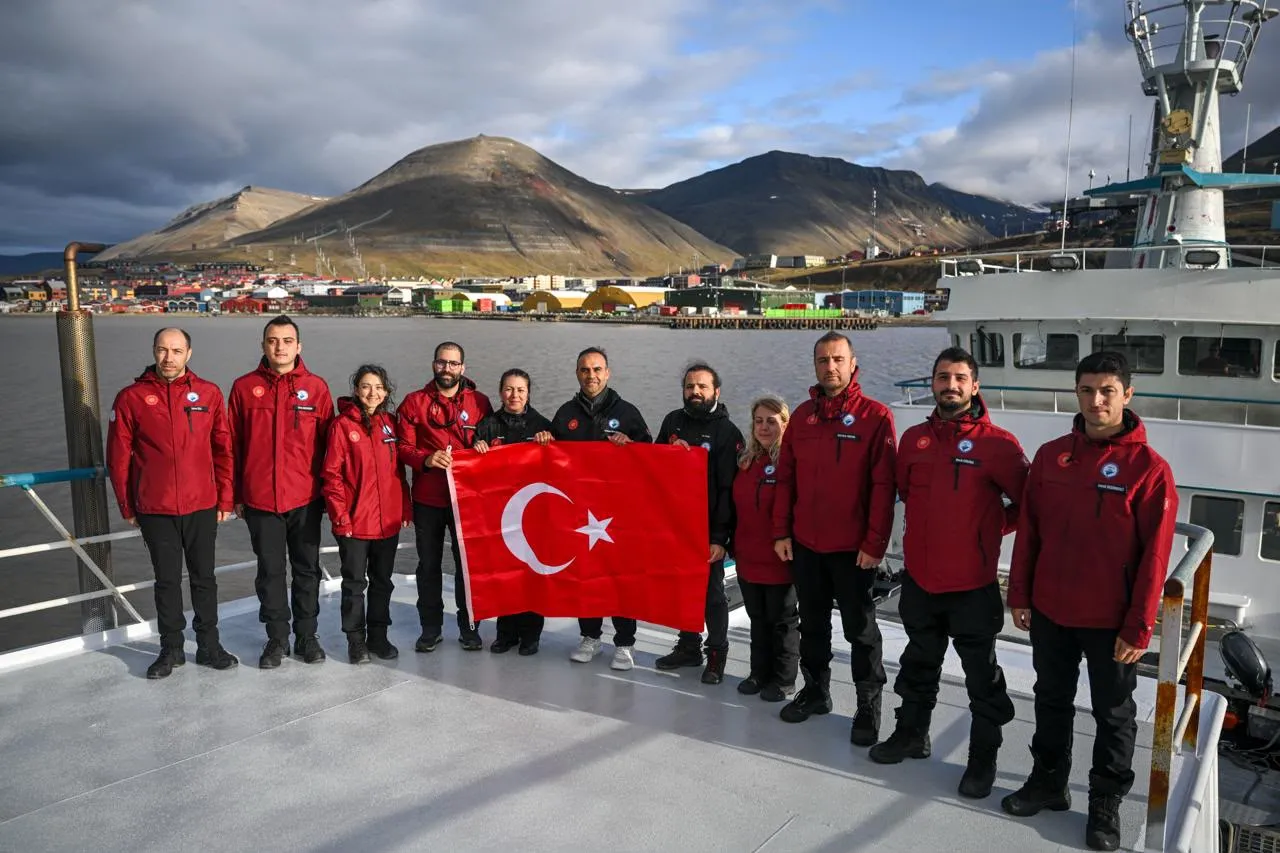
During a call with Prof. Dr. Burcu Özsoy, Coordinator of the 8th Antarctic Scientific Expedition, she noted that she was on board the ship with the expedition team and shared their location, saying, “We are at 62 degrees south latitude. It’s -7 degrees, so we can’t connect from outside, but we’re sailing through the Southern Ocean with glaciers behind us.” In response to a question from Prof. Dr. Mandal, Özsoy provided information about the 8th Antarctic Science Expedition and outlined the details of the 22 projects to be carried out during the expedition.
Özsoy, noting that there are no polar bears in Antarctica but that there are penguins there, said, “In addition to penguins, there are also seals and killer whales in the region. You should not get closer than 5 meters to the penguins. When we get off the plane, we also disinfect our feet with a special solution,” he added, sharing these interesting facts.
Answering the students“ questions, Özsoy noted that the weather conditions were challenging, mentioning the icebergs the ship passed by and the strong winds, and said, ”Weather conditions can change in an instant. That’s why we conduct meteorological measurements at our research station. We also monitor our researchers in the field via radio,” he said.
In response to another question, Özsoy explained how mission participants undergo rigorous training, emphasizing, “This work has legal, social, and communication dimensions, as well as specific behaviors that must and must not be exhibited in the field.”.
Noting that they had gained significant expertise during their previous expeditions, Özsoy mentioned that they had contributed to mapping efforts but pointed out that there were still gaps in the maps. Emphasizing the importance of international cooperation, Özsoy said, “We have cooperation agreements with various countries. One of them is Spain. Last year, a Turkish scientist participated in the expedition to Spain. This year, two researchers are participating in our expedition. We are witnessing positive developments not only through joint work with our Turkish scientists but also with scientists working on the same topics. We have been collaborating with Bulgaria for years. There is currently a Turkish scientist aboard the Colombian ship. And we have taken the first steps toward three field studies with the Czech team we met on the plane yesterday.”.
Responding to a question from Deputy Minister of Industry and Technology Prof. Dr. Ahmet Yozgatlıgil, Özsoy conveyed the researchers“ excitement, saying, ”Having a permanent Turkish research station in Antarctica and being able to work in the laboratories there is truly invaluable to us. “The feedback from other countries regarding the progress Turkey has made is also incredibly gratifying. Turkey’s success is being talked about. We are ready to pass this success on to future generations,” he emphasized.