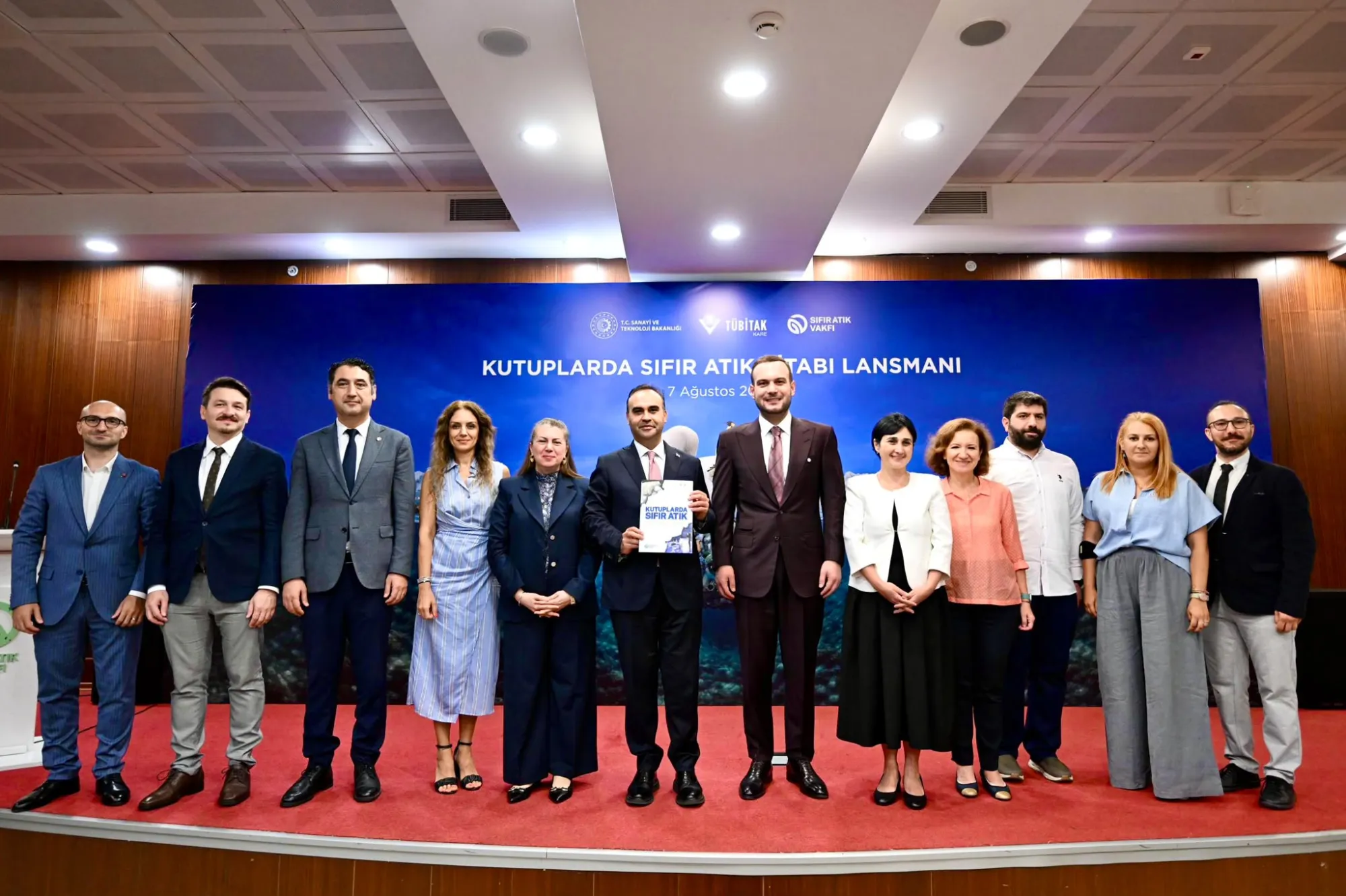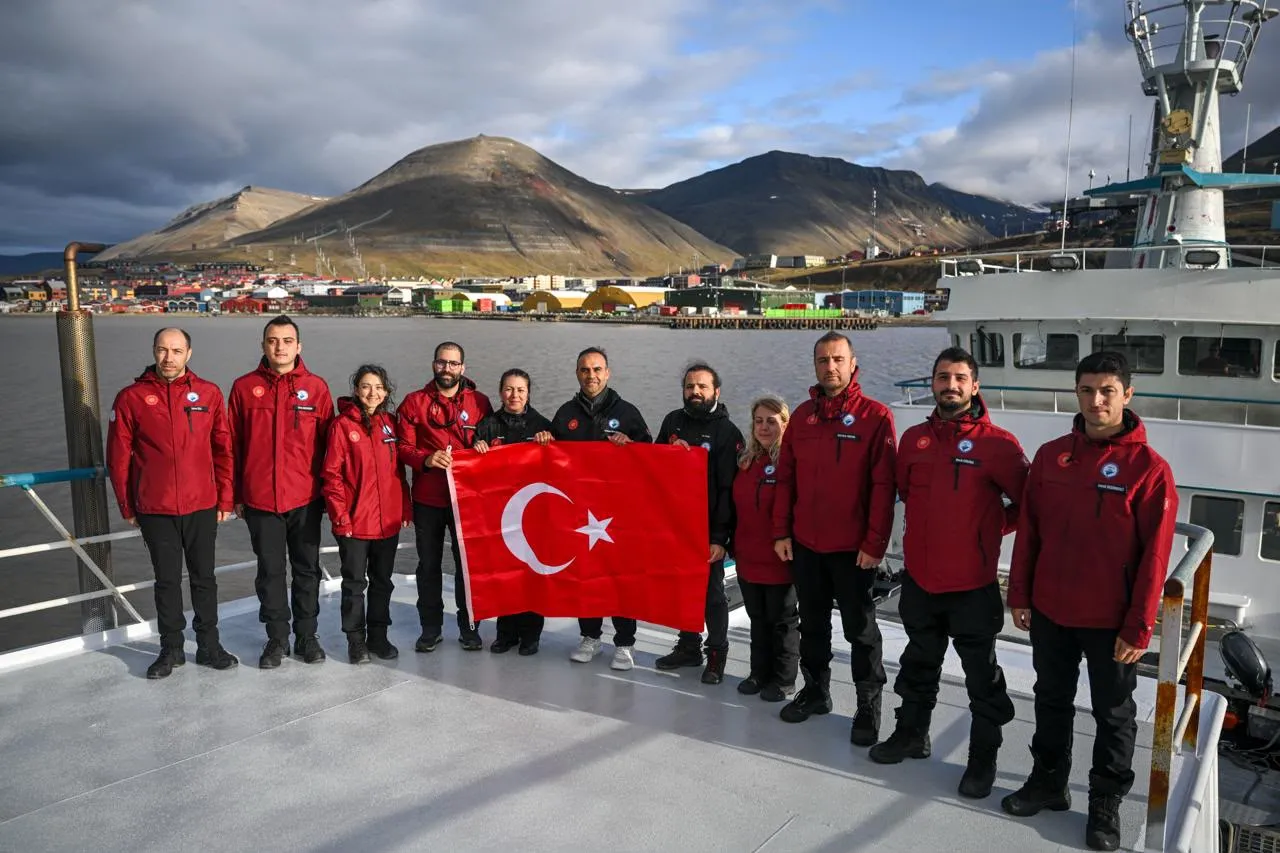


Minister of Industry and Technology Mehmet Fatih Kacır noted that the Turkish team conducting the 3rd National Arctic Scientific Research Expedition (TASE-III) had returned home with significant findings, stating, “We completed the expedition very successfully. Turkey will continue to be one of the leading countries in scientific research, just as it is in many other fields.”.
Kacır commented on the work of the scientific team that carried out the Arctic Expedition, which lasted about one month.
TÜBİTAK, the Naval Forces Command, the General Directorate of Meteorology, Anadolu Agency, research institutes, universities, and foreign scientists participating in the expedition as part of bilateral cooperation, Kacır stated that the research team conducted scientific studies by taking samples and making measurements at 28 stations, adding that these studies will yield results that will shed light on the future of the world. Kacır noted that the expedition team conducted scientific research for 14 different projects at sampling points in the Barents Sea, adding: “Our team investigated a wide range of topics, from the Arctic Ocean’s ecosystem to the status of fish and marine life, and from meteorological developments to atmospheric pollution. We completed the expedition very successfully. Just as in many other fields, Turkey will continue to be one of the leading countries in scientific research. As a government, we attach great importance to scientific research. We are taking steps that will contribute to the global scientific literature. Both our Antarctic and Arctic expeditions are a testament to this approach.”
Emphasizing that research on climate change and environmental pollution played a significant role in the expedition, Kacır stated that the findings—including the identification of marine pollutants and the observation of sea ice—would contribute to researchers working in these fields. Kacır reported that work was conducted at 28 different sampling points, stating, “The polar regions hold special significance for our scientists both because they are where climate change is occurring most rapidly and because of the wildlife they harbor. At the same time, the Arctic region is home to one-third of the world’s hydrocarbon reserves. The Northern Sea Route, which has recently come to the fore, appears poised to become one of the new trade routes. In a region that has become so strategic, we too will have our own research and a voice in the matter,” he remarked.
“The poles are crucial in the fight against climate change”
Emphasizing that scientific research has shown the Arctic region is affected by the impacts of global climate change twice as much as other regions, Kacır said, “Both the fact that these effects can be observed more clearly and the need to consider the world as a whole—including both polar regions—make this region valuable from a scientific research perspective. ”Given that the effects of global climate change are not limited to the polar regions, conducting scientific research in these areas to generate data that will shed light on the future is also important for all mid-latitude countries, including Turkey,” he said.
Kacır reported that research was conducted during the expedition on topics such as microplastics, biodiversity, air quality, marine pollution, renewable energy, maritime affairs, and oceanography. Explaining that analyses of parameters such as heavy metals, nutrients, and suspended solids in seawater samples collected from numerous locations throughout the expedition—to investigate levels of human-caused pollution in the environmentally vulnerable Arctic region—will be conducted at TÜBİTAK MAM laboratories, Kacır He also noted that physical parameters of seawater—such as temperature, dissolved oxygen, pH level, conductivity, and salinity—which affect the ecosystem, were measured at these locations. Kacır noted that the diversity of bacteria that break down microplastics—which pose a threat to seas and oceans—is also among the topics being studied as part of the expedition, and made the following remarks: “The aim is for the results obtained from bacteria adapted to cold climate conditions to contribute to biotechnological efforts to reduce plastic pollution in the seas in the future. Changes in phytoplankton and chlorophyll-a—key parameters for monitoring environmental impacts in the Barents Sea—were analyzed using aerial photographs taken by a drone during the expedition. The processed data will be used in research alongside existing satellite imagery covering vast areas. The data will be validated against in-situ measurements taken during the expedition to reveal the spatial distribution of environmental impacts in the region.”
Kacır stated that, with the help of the “Automatic Meteorological Observation Station” installed on the ship along its route, parameters such as wind speed, air temperature, humidity, pressure, global solar radiation, and sea surface temperature were measured and recorded. Minister Kacır added that these records will contribute to the local observation of climate change effects by providing input for existing climate models and remote sensing studies in the Arctic, where ground-based data is of low resolution.
“Research is being conducted on the potential for using solar energy“
TÜBİTAK President Prof. Dr. Hasan Mandal stated that the Naval Forces Command’s Directorate of Navigation, Hydrography, and Oceanography conducts measurements of color, light refraction, and visibility distance parameters at sea, adding that, “Since nearly 95 percent of the world’s seas and oceans—where the majority of global shipping takes place—remain unmapped, the measurements taken during these voyages will not only test the consistency of satellite-derived bathymetry data, but will also contribute to the production of new maps using remote sensing in this region, where maritime traffic is rapidly increasing.’.
Mandal reported that, as part of the expedition, existing open-source data regarding the enforcement of regulations on offshore fishing in the Arctic Ocean was analyzed, and that observations on the subject were made by gathering expert opinions from individuals engaged in fishing activities in the region. Mandal explained that particulate matter measurements were taken using continuous monitoring systems installed on the ship to determine air pollution levels along the expedition route, adding, “Thanks to these measurements, which are conducted every year, the impacts of industrial and maritime transportation activities in the region on air quality will be revealed. By comparing UV radiation data measured throughout the voyage with data from both polar regions, atmospheric factors affecting this parameter on a seasonal basis will be investigated. Furthermore, measurements taken on the photovoltaic thermal collector will provide information on the potential for using solar energy as a renewable energy source in the polar regions and on equivalent carbon emission values.”.
Mandal noted that, for the first time, the adsorbent material produced as part of the project—which won first place at the TEKNOFEST Turkey finals among the “TÜBİTAK 2204-D High School Students” Climate Change Research Projects”—was tested in the Arctic region, and he added that materials were collected with the aim of developing educational and awareness-raising activities related to the polar regions.
“Researchers from three different countries participated.“
Mandal, noting that researchers from Brazil, the Czech Republic, and Norway also participated in the expedition, stated the following: “Throughout the expedition, foreign researchers conducted studies on the genetic diversity of fish adapted to cold conditions in the Barents Sea, the impact of global climate change on phytoplankton distribution and diversity, and the implementation of maritime regulations in polar regions and the identification of their shortcomings. Additionally, as part of a collaboration with the Italian Institute for Polar Research, seawater and phytoplankton samples were collected and delivered to the Dirigibile Arctic Research Station in Ny-Ålesund. These collaborations added an international dimension to the expedition and contributed to our country’s efforts in science diplomacy. The process of becoming a party to the Svalbard (Spitsbergen) Treaty, coupled with the continued acceleration of scientific activities in the region, is laying a solid foundation for our country to attain observer status in the Arctic Council.”
TÜBİTAK President Mandal said that the initial findings from the researchers participating in the expedition will be shared with other scientists at the 7th National Polar Sciences Symposium, to be held November 30–December 1.