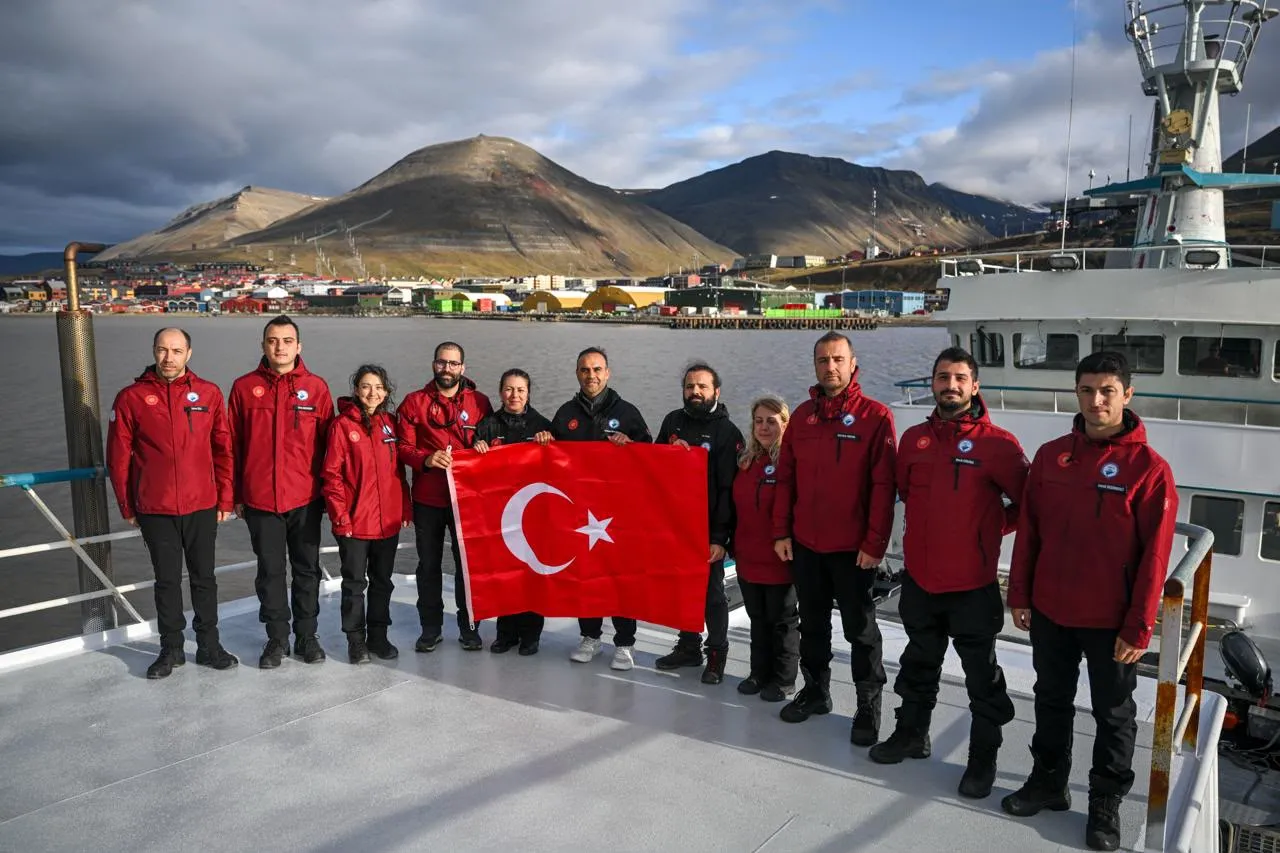


The scientific delegation that set out on the 2nd National Arctic Scientific Research Expedition—conducted under the auspices of the Presidency, organized by the Ministry of Industry and Technology, and coordinated by the TÜBİTAK MAM Institute of Polar Research—has returned to Turkey after a 22-day journey. The scientific findings from the research conducted during TASE II will enable us to uncover important insights, particularly regarding climate change and the green transition, and will significantly contribute to our country’s international scientific expertise in polar science.
Scientific research was conducted for 14 different projects
Expedition participants, along their route that veered 40 degrees north of Turkey, conducted zooplankton and phytoplankton sampling at 24 different sampling points in the Barents Sea; identified marine pollutants; monitoring physical parameters of seawater, conducting atmospheric pollution observations (including microplastics), meteorological observations, assessing the environmental impacts of shipping routes, observing sea ice, and tracking marine mammals.
A nine-person scientific team set out on July 4 aboard the 42-meter research vessel PolarXplorer to conduct a voyage in the Barents Sea in the Arctic Ocean. The scientists were supported in their work by a six-member ship’s crew consisting of Norwegian Captain Harry Johannessen, Third Officer Henrik Haveland, and Filipino crew members.
The team completed the expedition by crossing the Barents Sea and traveling as far north as 82 degrees north in Svalbard, where they collected samples. All the scientists conducted their research aboard the PolarXplorer research vessel.
Work will be conducted in the laboratory to analyze the data and marine samples and obtain results. Scientists will share the knowledge they gain from this research with the world through scientific articles and reports.
Both the air and sea temperatures were low
The expedition took place in the Barents Sea, in a region where the influences of the Atlantic and Arctic Oceans converge. Throughout the expedition, the team faced several adverse conditions—including dead waves and storms—but was most challenged by the drop in temperature. Sea water temperatures also fluctuated significantly. Starting at 10 degrees, the sea water temperature dropped to minus 1.2 degrees, allowing the team to work in icy waters.
One unique aspect of working in the Arctic Ocean is that, due to the latitude, you are within the Arctic Circle, so it is always sunny—day and night. This allows for 24-hour work shifts. However, this also disrupted the team’s biological rhythms, making it one of the factors that posed a challenge to the team.
Scientists took turns observing the mammals
One of the major projects carried out focused on the observation of marine mammals… A different approach was taken in this context. All the scientists took four-hour shifts on the ship’s bridge to observe the mammals.
During their expedition spanning approximately 4,000 kilometers, Turkish scientists observed sea ice starting at 82 degrees north latitude, the glaciers of the Svalbard archipelago, and, as they sailed through the Barents Sea, humpback whales, minke whales, beluga whales, various species of dolphins and seals, walruses, polar bears, and dozens of bird species.
Visit to the Polish Station by the Turkish Science Team There are 20 research facilities belonging to 13 countries on Spitsbergen Island, established to conduct scientific research on the North Pole and the Arctic Ocean. During the expedition, the Turkish scientific team also visited the Polish Polar Research Station on Spitsbergen Island in Svalbard.