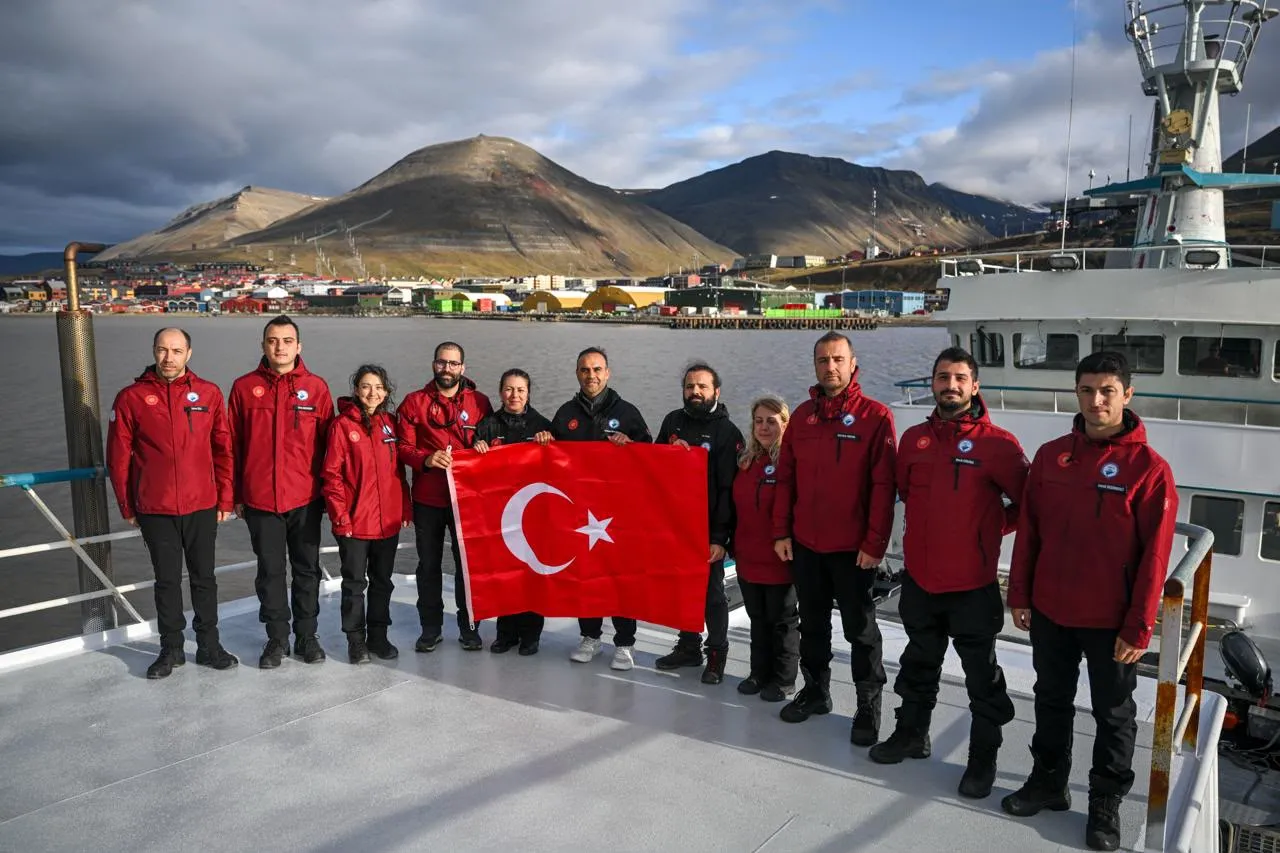


In the 100th year of the Republic of Turkey, the Seventh National Antarctic Science Expedition (TAE VII) was successfully completed between January 30 and March 4, 2023, under the patronage of the Presidency, administered by the Ministry of Industry and Technology, coordinated by the TÜBİTAK MAM Institute of Polar Research, and led by expedition coordinator Prof. Dr. Burcu Özsoy.
The 19-member research team participating in the fieldwork for this expedition traveled approximately 15,000 kilometers on four different flights, starting from Istanbul Airport, first to the South American continent, and from there to King George Island, the northernmost point of the Antarctic continent. After arriving on the island, the team boarded the 80-meter-long ship named Betanzos and sailed along the western coast of the Antarctic Peninsula in the Southern Ocean until March 2. In addition to the work conducted at the Turkish Scientific Research Camp on Horseshoe Island, the team also carried out scientific research on Dismal Island and King George Island. The team also visited various other regions, such as Livingston and Greenwich Islands, and visited a total of eight different foreign research stations, carrying out collaborative research as part of bilateral partnerships.
Throughout the expedition, the team—which had the opportunity to work during the day at an average temperature of 0 degrees—collected various data on numerous research topics, particularly global climate change. At the start of the expedition, the Ambassador of the Republic of Turkey to Santiago and the expedition coordinator accompanied the team to Antarctica. Through international engagements, they played a significant role in promoting Turkey’s polar research to the world and strengthening bilateral cooperation. In addition, three students from the team that won first place in this year’s 2204-C High School Students’ Polar Research Projects Competition participated in the expedition for the first time, gaining the opportunity to implement their projects in Antarctica.
Maintenance and upkeep work was also carried out on the continent’s four automatic data stations—comprising GNSS (Global Navigation Satellite System) and meteorological equipment—and they were prepared for winter conditions. Maintenance was also performed on the Turkish Scientific Research Camp, which consists of three modules, and new solar panels were installed on one of the modules. During the expedition, a wide range of research—from earth sciences to life sciences, and from physical sciences to social and humanities—was conducted as part of 18 projects. Numerous scientific samples collected from the continent—including ice, water, snow, rocks, algae, and lichens—were brought back to research laboratories in Turkey for analysis.