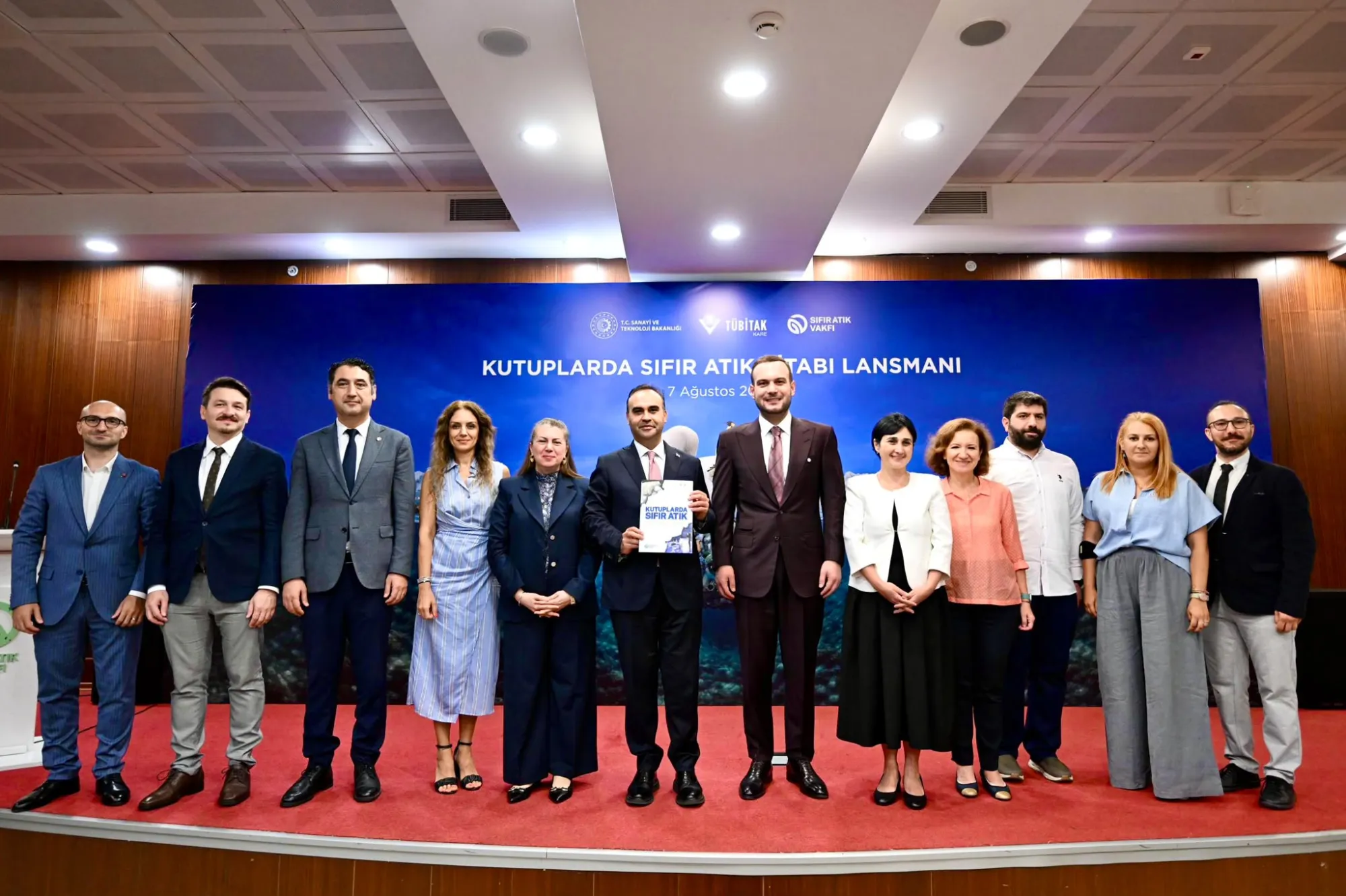


Ceremony to Unveil and Hand Over Domestic Technologies to Be Used in the 6th National Antarctic Science Expedition: Minister of Industry and Technology Mustafa Varank, Ankara Governor Vasip Şahin, President of the Scientific and Technological Research Council of Turkey (TÜBİTAK) Prof. Dr. Hasan Mandal, Prof. Dr. Burcu Özsoy, Director of the TÜBİTAK Marmara Research Center’s Institute of Polar Research (MAM-KARE) and Expedition Coordinator; Gürcan Okumuş, Director of TÜBİTAK SAGE; ASELSAN Board Chairman and General Manager Prof. Dr. Haluk Görgün, HAVELSAN General Manager Dr. Mehmet Akif Acar, and TÜRKSAT Deputy General Manager for Satellite Services Dr. Selman Demirel.
“Our goal is to obtain “Advisory State” status under the Antarctic Treaty, fly our flag there, and have a say in the future of the White Continent.”
Speaking at the ceremony, Minister of Industry and Technology Mustafa Varank noted that efforts are underway to build a great and powerful Turkey across many fields, ranging from the defense industry to digital technologies, and from electric vehicles to space exploration. Minister Varank said, “Polar research is also one of the important activities we are carrying out as part of this vision.”.
Varank said, “Our goal is to obtain “Advisory State” status under the Antarctic Treaty, fly our flag there, and have a say in the future of the white continent.”.
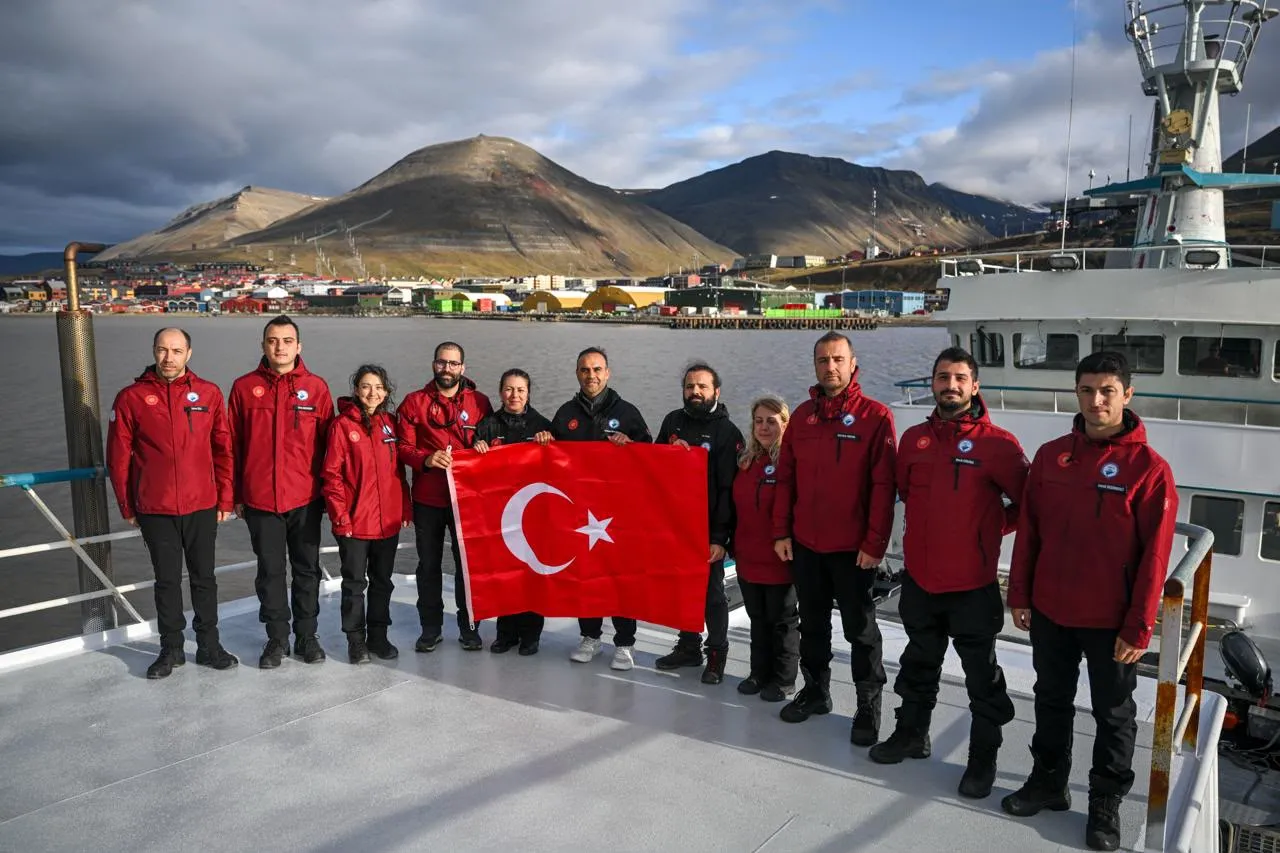
Recalling that five scientific expeditions have been organized to the continent since 2017, Minister Varank noted that the sixth expedition, with a 20-person team, will set out on January 22. Varank said, “I am aware that this is a very exciting process for those dedicated to polar science. Believe me, I’m just as excited as you are,” he said, adding that he would like to participate in the polar expedition and expressing his hope that “God willing, I’ll have the opportunity to join the expedition after my term as minister ends.”.
“I am proud that our country ranks among the leaders in polar research.”
Noting that the poles serve as natural laboratories—crucial areas that shed light on the world’s past and present—Minister Varank said, “Every discovery made here is invaluable in terms of understanding nature, living organisms, and the Earth. “The solutions to many problems—climate change foremost among them—are actually hidden here. ”Therefore, I am proud that our country is at the forefront of these studies, which could yield results of global significance,” he said.
Noting that the team will embark on a challenging journey lasting about a month and a half, Varank said, “This is what the love of science is all about! Braving every kind of hardship, leaving their families behind, and making new discoveries for the sake of our country and humanity. I would like to take this opportunity to once again congratulate them from the bottom of my heart. I hope they travel safely, return home safely, and achieve very successful results.”.
“Just as we are sending our polar researchers off on their expedition today, we will be sending our astronauts off into space in the very near future.”
Minister Varank emphasized, “Just as we are sending our polar researchers on their expedition today, we will also be sending our astronauts into space in the very near future. We believe this wholeheartedly.”.
Minister Varank noted that detailed research will be conducted as part of exactly 14 projects in the fields of Earth Sciences, Life Sciences, and Physical Sciences during the mission, and emphasized that the projects will be carried out in collaboration with 29 institutions.
“Our international collaborations also demonstrate just how much progress we’ve made in our newly launched polar research.”
Minister Varank, who also highlighted international collaborations, said, “Two foreign researchers—one from Portugal and one from Bulgaria—have been included in the team. Our two Turkish researchers are also currently continuing their work at a South Korean research station. This actually demonstrates just how much progress we’ve made in our polar research, which is still in its very early stages.”.
“In the spirit of the National Technology Initiative and using domestic resources, we are making many technological products developed in this way available to the mission team for testing.”
Varank emphasized the importance of the expedition, stating, “We are making many technological products—developed in the spirit of the National Technology Initiative and using domestic resources—available to the expedition team for testing. ”Personally, I consider this step to be of great value for the future of polar research and many other scientific research projects,” he said, highlighting the importance of the expedition.
Noting that work at the poles takes place under extremely harsh weather conditions, Minister Varank said, “For this reason, the reliability of the machinery and equipment to be used here is crucial—both for the team’s safety and for the quality of the work. Consequently, if you are dependent on foreign sources for this machinery and equipment, the sustainability of your work is at great risk. Continuously sourcing these items from abroad will result in significant costs. More importantly, the sources from which you procure these technological products can very easily cease supplying you. Polar research also holds great potential, both in terms of the economic value it can generate and in terms of prestige. For this reason, there is intense international competition in this field. ”You cannot guarantee that your competitors, upon seeing that your work has reached a certain stage, will not resort to such measures to disrupt it,” he said.
“We will manufacture the high-tech machinery and equipment that our teams will use on these missions using domestic and national resources.”
“That is why we are integrating our polar research with our national technology vision to strengthen our country’s claim to be a key player in this field. We are incorporating polar research into the steps we are taking with the goal of making our country a producer—not just a market—of critical technologies,‘ said Varank. ’We have developed significant partnerships with the leading institutions in our satellite, telecommunications, aviation, and defense industries. This way, we will produce the high-tech machinery and equipment that our teams will use on these expeditions using domestic and national resources.”.
Varank noted that this impact would not be limited to polar research alone but would extend to many other fields, particularly the defense industry and information and communication technologies. Finally, Minister Varank shared details, noting that this time, the team will be accompanied by very important products and services developed by five distinguished institutions.
“TÜBİTAK has long been active with the aim of ensuring that Turkey has a say in the future of Antarctica and the Arctic and in the protection of the polar regions.”
In his opening remarks, TÜBİTAK President Prof. Dr. Hasan Mandal emphasized that in recent years, climate change and environmental issues have had an increasing impact on the world and Turkey, noting that due to the complex, dynamic, and ever-changing nature of these issues, it is impossible to resolve them through a single discipline or a single perspective. Prof. Dr. Mandal stated that TÜBİTAK generates solutions to these complex, dynamic, and ever-changing problems through an approach of “working together, developing together, and succeeding together,” which facilitates collaboration across different disciplines.
Mandal, noting that TÜBİTAK has long been carrying out activities with the aim of ensuring that Turkey has a say in the future of Antarctica and the Arctic and in the protection of the polar regions, recalled that in 2017, under the patronage of the Presidency and the supervision of the Ministry of Industry and Technology, Turkey organized its first national scientific expedition to Antarctica to position itself among the leading countries in scientific research and technology development. Noting that the establishment of the TÜBİTAK Marmara Research Center Institute of Polar Research (MAM KARE) in 2019 gave a new dimension to work in the polar regions, TÜBİTAK President Prof. Dr. Hasan Mandal said, ’With the establishment of TÜBİTAK MAM KARE, we began coordinating our scientific expeditions to the polar regions in line with the National Polar Science Program, in collaboration with the Ministry of Industry and Technology of the Republic of Turkey,“ he said.
“The “thermal batteries” developed using domestic and national resources have eliminated our defense industry’s reliance on foreign sources.”
Prof. Dr. Mandal, while highlighting the importance of the sixth mission to be carried out on January 22, emphasized that various institutions and organizations in our country are supporting the mission with domestically produced products. Prof. Dr. Mandal noted that the “thermal batteries”—which are among these products and were developed by TÜBİTAK using domestic and national resources—have eliminated our defense industry’s dependence on foreign sources. He stated that the use of thermal batteries developed by the TÜBİTAK Defense Industry Research and Development Institute (SAGE), will provide numerous advantages, Mandal said, adding, “Thanks to the thermal energy generated by these batteries, the research team’s needs for heating and drinking water in emergency situations can be met.”.
Mandal pointed out that thermal batteries stand out from their alternatives due to features such as long shelf life, no maintenance requirements, the ability to provide high energy in short periods, rapid activation, no self-discharge, high reliability, a wide operating temperature range, and resistance to harsh environmental conditions, “Thermal batteries, which can deliver the expected performance even at -90 degrees, will fulfill their mission seamlessly—especially in emergency situations—under Antarctica’s extremely cold climate conditions, where other battery technologies cannot operate,” he stated. TÜBİTAK President Prof. Dr. Mandal also emphasized that thermal batteries, with their long shelf life, can be stored for more than 20 years under Antarctic conditions and retain their initial energy level even after 20 years without requiring any maintenance. Mandal also noted that all their work in this field demonstrates that Turkey has transformed from a country that merely follows technological developments into one that produces and develops these technologies using its own resources.
Mandal emphasized that, as TÜBİTAK, they aim not only to develop and produce these technologies but also to build a qualified workforce to conduct research in this field. To this end, he noted that they have organized the “Polar Festival,” Polar Sciences Workshops, and that they support young people’s projects in this field through the 2204-C High School Students’ Polar Research Projects Competition, which they organize as part of TEKNOFEST.
Finally, Mandal thanked all the organizations that provide the critical technologies Turkey needs, the Anadolu Agency, which will provide communications support for the Science Expedition, and President Recep Tayyip Erdoğan and Minister of Industry and Technology Mustafa Varank, who have never failed to offer their support for these efforts.
Expedition Coordinator Prof. Dr. Burcu Özsoy shared details about the expedition
TÜBİTAK MAM Polar Research Institute (KARE), Director and Expedition Coordinator Prof. Dr. Burcu Özsoy provided information regarding the expedition, which will take place from January 22 to March 3, 2022. Emphasizing that the expedition will take place under COVID-19 precautions, Özsoy shared details about a total of 14 projects to be carried out in collaboration with 29 different institutions, including seven in the Life Sciences, four in the Earth Sciences, and three in the Physical Sciences.
Prof. Dr. Özsoy also touched on international collaborations, stating, “Two Turkish researchers are conducting their work at the King Sejong Antarctic Station in South Korea, and one researcher each from Bulgaria and Portugal will also be joining us on the Sixth National Antarctic Science Expedition.”.
TÜBİTAK SAGE thermal batteries will play a key role in challenging conditions
“As SAGE, our thermal battery—for which we possess the full range of design, development, and production capabilities—is setting off to serve on the 6th National Antarctic Science Expedition in the polar region, where harsh environmental conditions prevail.“ said Gürcan Okumuş, Director of the TÜBİTAK Defense Industry Research and Development Institute (SAGE), emphasized the advanced features of these high-tech thermal batteries—developed and manufactured domestically by Turkish engineers—including high reliability, a shelf life of at least 25 years, maintenance-free operation, and rapid activation.
Okumuş said, “Batteries, which are an irreplaceable power source capable of operating at full capacity even at extremely low temperatures such as -90°C, will be ready for use in Antarctica—the coldest place on Earth and known for its harsh climatic conditions— in the event of an urgent, rapid, and reliable need for electrical energy, and will contribute to ongoing scientific research and development.”.
ASELSAN Provides Radio Support to the Antarctic Team
Haluk Görgün, Chairman of the Board and General Manager of ASELSAN, also said that they were following the work being carried out in Antarctica under the leadership of TÜBİTAK on behalf of Turkey with great excitement, curiosity, and pride.
Görgün, noting that ASELSAN has sent radio and modular mobile repeater radio systems to Antarctica for testing and operational use, stated that these communication products—developed using domestic and national capabilities and tested under the most extreme conditions—will serve as a reliable support for scientists in an extremely challenging environment. Highlighting that the 15 award-winning 3700 handheld radios they sent to Antarctica are among ASELSAN’s most successful communication products in their class, Görgün said, “By adding yet another success to the track record our radios have established in many challenging environments around the world, they will serve as a lifeline for our teams in the harsh polar environment,” he said.
Görgün added that the “Portable Hybrid Power Support Unit”—which generates energy using high-efficiency solar panels to ensure uninterrupted system operation and can be installed by just two people—will also provide energy support to scientists in Antarctica, where there is no electrical infrastructure.
HAVELSAN Unveiled Its GNSS Receiver
HAVELSAN General Manager Mehmet Akif Nacar also noted that they had held their first meetings with TÜBİTAK MAM KARE officials noting that they had held their first meetings at TEKNOFEST 2021, and emphasized that they had developed the HAVELSAN GNSS receiver in as little as four months and that it would be used for the first time on the national polar expedition to Antarctica.
Nacar noted that the HAVELSAN GNSS receiver calculates position using satellites from many different countries—such as GPS, Galileo, Beidou, Glonass, and QZSS to calculate position and provide global coverage,“ Nacar stated, adding, ”The HAVELSAN GNSS receiver offers real-time position, velocity, and time information along with uninterrupted operational performance.”.
Minister Varank presented the products to the mission team
Following the speeches, Minister Varank handed over the products to mission coordinator Prof. Dr. Burcu Özsoy and said, “Developing these technologies and being able to test them in the field gives our institutions a significant advantage. You know the difference it makes when you bring tested products to market today. I place great importance on our companies testing their products. ASELSAN, HAVELSAN, and SAGE will conduct one of the most challenging tests in Antarctica. God willing, if we can establish a permanent base there, we’ll go together and test them on-site.”.